
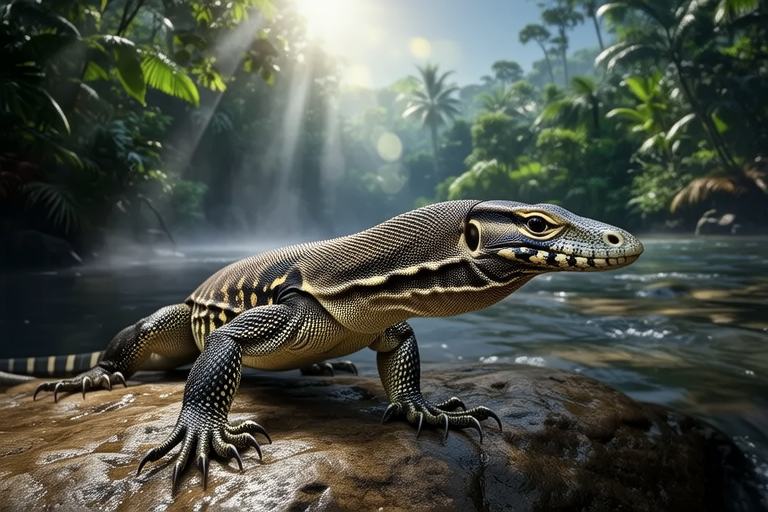
Top 10 Fascinating Facts About the Magnificent Water Monitor
The water monitor (Varanus salvator) is one of the largest lizards in the world, known for its impressive size, agility, and adaptability. Found across Southeast Asia, this reptile is a marvel of evolution, showcasing remarkable physical features, behaviors, and ecological roles. Here are ten fascinating facts that highlight the water monitor’s unique biology and ecological significance.
Fact 1: The Largest Lizard Species
The water monitor can grow up to 3 meters (9.8 feet) in length and weigh as much as 50 kilograms (110 pounds), making it one of the largest lizard species alive today. This size allows it to dominate its environment, preying on a wide range of animals and deterring potential predators. Its elongated body, muscular limbs, and powerful tail are well-adapted for both terrestrial and aquatic activities.
Fact 2: Adept Swimmer
The water monitor is an excellent swimmer, capable of diving to depths of up to 4.5 meters (15 feet) and remaining submerged for up to 30 minutes. It uses its long, flattened tail as a rudder and propeller, enabling swift movements through water. This adaptation allows the water monitor to exploit aquatic environments, searching for prey and escaping threats. The term ‘bipedal locomotion’ refers to its ability to run on two legs, which it does when moving quickly on land.
Fact 3: Versatile Diet
This omnivorous lizard has a varied diet that includes fish, crustaceans, small mammals, birds, eggs, insects, and even carrion. Its strong jaws and sharp teeth enable it to consume hard-shelled prey like crabs and turtles. The water monitor plays a crucial role in maintaining ecosystem balance by controlling populations of smaller animals and recycling nutrients through scavenging.
Fact 4: Unique Hunting Techniques
Water monitors employ various hunting strategies, including ambush predation and active foraging. They often lie in wait near water bodies or in dense vegetation, striking when potential prey comes within reach. Their keen sense of smell helps them locate hidden food sources, while their excellent vision allows them to spot distant targets. Additionally, they use their forked tongues to detect chemical cues in the air, a process known as chemoreception.
Fact 5: Exceptional Climbing Abilities
Equipped with sharp claws and strong leg muscles, water monitors are skilled climbers. They can scale trees, walls, and other vertical surfaces with ease. This ability provides access to additional food sources, such as nesting birds and arboreal insects, and serves as a means of escape from ground-based threats. Their climbing prowess also aids in thermoregulation, allowing them to bask in sunny spots high above the ground.
Fact 6: Complex Social Structure
Contrary to popular belief, water monitors exhibit complex social behaviors. Males establish territories and engage in ritualistic combat during the breeding season, using their tails and teeth in displays of dominance. Females lay clutches of up to 40 eggs, which they bury in sandy soil or leaf litter for incubation. Hatchlings are independent from birth and must fend for themselves, relying on camouflage and speed to avoid becoming prey.
Fact 7: Adaptations for Survival
The water monitor possesses several adaptations that enhance its survival. For instance, its rough, scaly skin provides protection against abrasions and parasites. Additionally, its nostrils are positioned high on its snout, allowing it to breathe while partially submerged. Another adaptation is the presence of a nictitating membrane, a transparent eyelid that protects the eyes during swimming and climbing.
Fact 8: Temperature Regulation
Like all reptiles, water monitors rely on external heat sources to regulate their body temperature. They bask in sunlight to warm up and become more active, and seek shade or water to cool down when overheated. This behavior, known as thermoregulation, ensures optimal physiological functioning and energy efficiency. Their dark coloration aids in heat absorption, while lighter areas help dissipate excess warmth.
Fact 9: Role in Ecosystems
Water monitors play vital roles in their ecosystems. As predators, they control populations of smaller animals, preventing overgrazing and competition for resources. By scavenging, they contribute to nutrient cycling and decomposition processes. Furthermore, their burrowing activities aerate soil and create habitats for other organisms. Their presence is indicative of healthy, diverse ecosystems.
Fact 10: Conservation Challenges
Despite their ecological importance, water monitors face numerous threats, including habitat destruction, illegal trade, and human persecution. Deforestation, agricultural expansion, and urbanization have reduced their natural habitats, forcing them into closer contact with humans. Consequently, many individuals are captured for the pet trade or killed due to fear or misunderstanding. Conservation efforts are essential to protect these magnificent creatures and preserve their habitats.
The Importance of Conservation
Conserving water monitors and their habitats is crucial for maintaining biodiversity and ecosystem health. These lizards serve as indicators of environmental quality and play critical roles in regulating animal populations and nutrient cycles. By protecting their habitats and addressing the root causes of their decline, we can ensure the survival of these fascinating creatures for future generations.