
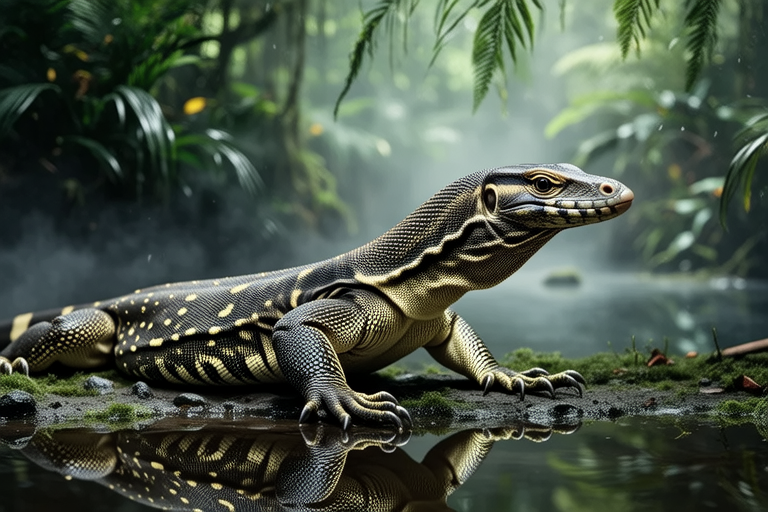
The Mysterious Life of Water Monitors: Facts and Myths You Need to Know
Water monitors (Varanus salvator) are among the most fascinating reptiles on Earth. These large lizards have captured the imagination of people for centuries, often shrouded in mystery and misconception. In this article, we delve into the scientific facts about water monitors, exploring their habitat, diet, behavior, and physical characteristics. We also address common myths surrounding these creatures, debunking them with factual information.
Habitat and Distribution
Water monitors are native to Southeast Asia, where they inhabit a wide range of environments, from coastal mangroves to freshwater swamps, rivers, and even urban areas. They are highly adaptable and can be found in countries such as India, Bangladesh, Nepal, Sri Lanka, Myanmar, Thailand, Cambodia, Vietnam, Malaysia, Indonesia, and the Philippines. Their ability to thrive in diverse habitats has contributed to their widespread distribution.
One lesser-known fact is that water monitors are excellent swimmers, capable of holding their breath for up to 30 minutes. This adaptation allows them to explore submerged environments, searching for prey or escaping predators. Their streamlined bodies and powerful tails make them efficient swimmers, enabling them to navigate through water with ease.
Physical Characteristics
Water monitors are impressive in size, with males typically reaching lengths of 1.5 to 2 meters and weighing up to 20 kilograms. Females are generally smaller, measuring around 1 meter in length. The largest recorded water monitor was over 3 meters long and weighed approximately 50 kilograms. Despite their size, water monitors are agile and quick, thanks to their muscular bodies and sharp claws.
These lizards have a long, forked tongue that they use to detect chemical signals in the air, similar to snakes. When the tongue is flicked out, it picks up scent particles and transfers them to the Jacobson’s organ in the roof of their mouth, helping them locate food and potential mates. Another interesting feature is their strong jaws, equipped with sharp teeth designed for gripping and tearing flesh.
Diet and Feeding Habits
Water monitors are opportunistic omnivores, meaning they eat both plant and animal matter. Their diet primarily consists of small mammals, birds, eggs, insects, fish, crustaceans, and amphibians. They are known to raid bird nests, consuming eggs and nestlings. Additionally, they scavenge on carrion, playing a crucial role in maintaining ecosystem balance by removing dead animals.
There is a myth that water monitors hunt humans, which is entirely false. While they may appear intimidating due to their size and aggressive demeanor, they pose no threat to humans unless provoked. In reality, water monitors are more likely to avoid human interaction, as they prefer to remain undisturbed in their natural habitats.
Behavior and Social Structure
Water monitors are solitary creatures, only coming together during the breeding season. Males compete for access to females through ritualized displays and combat, with the victor gaining mating rights. After mating, females lay clutches of 10 to 60 eggs, which they bury in sandy soil or leaf litter. Incubation lasts approximately 8 to 10 months, depending on environmental conditions.
Anecdotal evidence suggests that water monitors have a keen sense of curiosity. Observers have reported instances where these lizards have approached humans out of sheer interest, investigating objects and movements. However, this curiosity should not be mistaken for aggression. Water monitors are generally wary of humans and will retreat if threatened.
Myths Debunked
One common myth is that water monitors are venomous. While they do possess glands near their teeth that secrete a mild toxin, it is not potent enough to harm humans. Another misconception is that water monitors are aggressive towards humans. As mentioned earlier, they are more likely to flee than confront a potential threat. It is important to dispel these myths to prevent unnecessary fear and misunderstanding of these remarkable creatures.
Another myth is that water monitors can predict earthquakes. There is no scientific evidence to support this claim. While some anecdotal reports suggest unusual behavior before seismic events, these observations are not consistent or reliable enough to draw definitive conclusions.
Cultural Significance
In many cultures, water monitors hold significant symbolic meanings. For example, in Hindu mythology, the water monitor is associated with the god Vishnu, who is believed to have taken the form of a half-man, half-lizard creature to protect the world. Similarly, in Filipino folklore, water monitors are considered sacred animals, believed to bring good fortune and protection to those who respect them.
Water monitors have also been used in traditional medicine, although there is no scientific basis for the purported health benefits. It is essential to approach these cultural practices with caution and respect, recognizing the importance of preserving these traditions while promoting responsible conservation efforts.
Conservation Status
Despite their widespread distribution, water monitors face various threats, including habitat loss, illegal hunting, and the pet trade. Habitat destruction due to deforestation, agriculture, and urbanization has led to a decline in suitable environments for these lizards. Additionally, water monitors are hunted for their meat, skin, and fat, which are used in traditional medicine and as aphrodisiacs.
Efforts to conserve water monitors include establishing protected areas, raising public awareness, and implementing sustainable hunting practices. By supporting conservation initiatives and promoting responsible tourism, we can help ensure the survival of these magnificent creatures for future generations.
Conclusion
The mysterious life of water monitors is a testament to the wonders of nature. From their impressive size and swimming abilities to their curious behavior and cultural significance, these lizards continue to captivate and inspire. By understanding the facts and debunking myths surrounding water monitors, we can foster a greater appreciation for these remarkable creatures and work towards their conservation.