
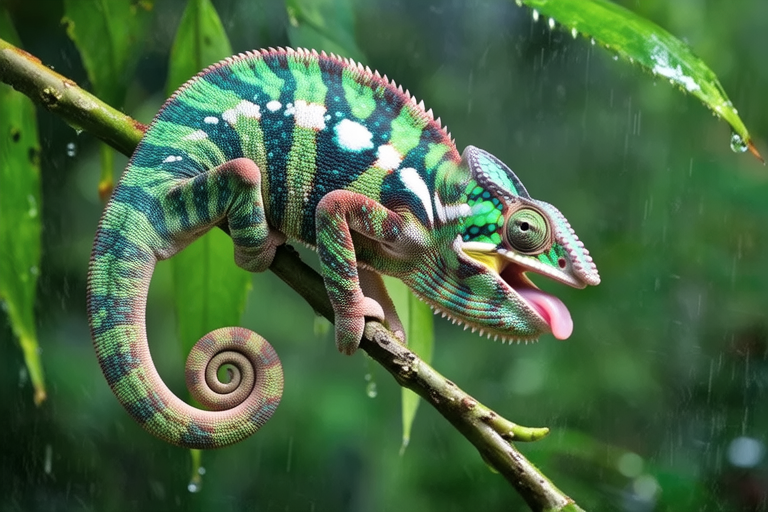
Top 10 Fascinating Facts About Chameleons You Didn’t Know
Chameleons, those quirky reptiles famous for their ability to change color, have captured the imagination of humans for centuries. Beyond their colorful display, these creatures possess a myriad of unique adaptations that make them one of the most intriguing animals on Earth. Let’s dive into ten fascinating facts about chameleons that you probably didn’t know.
1. Chameleons Have Z-shaped Tongs
Did you know that chameleons have tongues that can be twice as long as their bodies? Their tongs are equipped with a sticky tip that can shoot out at incredible speeds, allowing them to catch insects mid-air. This adaptation is crucial for their survival in the wild, where speed and precision are essential. The tongue’s rapid movement, which can reach up to 26 body lengths per second, is powered by muscles and elastic tissue, making it one of the fastest known movements in the animal kingdom. This remarkable hunting tool not only helps them secure food but also ensures they can thrive in environments where food sources may be scarce.
Their unique feeding mechanism has evolved to perfection over millions of years, but there’s much more to these fascinating creatures than just their tongues. Next, let’s explore another extraordinary feature of chameleons: their eyes.
2. Independent Eye Movement
One of the most striking features of chameleons is their ability to rotate their eyes independently. This means each eye can move in different directions simultaneously, giving them a nearly 360-degree field of vision. This adaptation allows chameleons to spot potential threats or prey without moving their head, which is particularly useful when they need to remain still and undetected. Interestingly, this unique visual system enables them to perceive depth better than many other animals, including humans. With such an advanced visual system, chameleons can precisely aim their tongues at targets, even when they’re obscured by leaves or branches.
While their eyes provide exceptional vision, chameleons have another trick up their sleeves—literally. Their feet are designed in a way that sets them apart from other lizards. Let’s take a closer look at how these specialized feet help them navigate their environment.
3. Unique Foot Design
Chameleons have zygodactyl feet, meaning their toes are fused into two groups of opposing digits. On their front feet, two toes point inward, while three point outward; on their hind feet, this arrangement is reversed. This design provides a strong grip on branches and trees, allowing chameleons to climb and move effortlessly through their arboreal habitats. Additionally, their feet are covered in small scales called lamellae, which increase surface area and friction, further enhancing their climbing abilities. This specialized foot structure is so effective that chameleons can even walk upside down along branches if necessary. This remarkable adaptation ensures that they can maintain their position in the canopy, away from ground-dwelling predators.
Chameleons’ feet are just one part of their impressive physical toolkit. Another remarkable feature is their tail, which plays a significant role in their lifestyle. Let’s find out how this appendage contributes to their survival.
4. Prehensile Tail
The prehensile tail of chameleons acts like a fifth limb, providing balance and support while climbing. They can wrap their tails around branches to anchor themselves securely, which is especially useful when they need to rest or sleep in precarious positions high above the ground. In addition to its practical functions, the tail also serves as a communication tool. Chameleons can use it to signal aggression or submission to other chameleons. For instance, a relaxed tail indicates a calm and non-threatening demeanor, whereas a tightly coiled tail might suggest stress or agitation. This versatile appendage is a vital part of their anatomy, contributing both to their physical stability and social interactions.
Chameleons’ tails are just one aspect of their complex social lives. Another intriguing behavior is their color-changing abilities, often misunderstood as merely camouflage. Let’s uncover the true purpose behind this iconic trait.
5. Color-Changing for More Than Just Camouflage
Contrary to popular belief, chameleons don’t change color primarily for camouflage. Instead, their color shifts serve multiple purposes, including temperature regulation, communication, and mood expression. By adjusting the spacing between cells containing pigments, chameleons can alter the wavelengths of light reflected off their skin, changing their appearance. This process is controlled by neural signals and hormones, allowing them to display vibrant colors during mating rituals or when defending territory. For example, males may turn bright red or orange to attract females or intimidate rivals. Understanding the true function of their color-changing abilities reveals the complexity of chameleons’ interactions within their ecosystems.
Chameleons’ color-changing abilities are indeed fascinating, but there’s another surprising aspect of their biology that few people know about. Let’s delve into the world of chameleon hearing and learn why they are sometimes considered deaf.
6. Perceiving Sound Differently
Despite having ears, chameleons are often described as being “deaf” because they rely less on sound than other animals. Their auditory systems are less developed compared to those of mammals or birds, and they lack external ear structures. However, this doesn’t mean they cannot hear at all. Chameleons can detect vibrations and low-frequency sounds through their bones, a process known as bone conduction. This method of hearing is less sensitive than traditional ears but sufficient for detecting environmental changes, such as approaching predators or potential mates. While they may not be able to enjoy the symphony of nature like some animals, their unique hearing system is perfectly adapted to their needs in the wild.
Chameleons’ auditory adaptations are just one piece of the puzzle. Another aspect of their biology that sets them apart is their reproductive habits. Let’s explore how chameleons reproduce and care for their young.
7. Viviparous Reproduction
Unlike many reptiles, chameleons are viviparous, meaning they give birth to live young instead of laying eggs. This adaptation allows them to protect their offspring in harsher environments where egg-laying could be risky. Female chameleons can carry up to 80 babies at a time, depending on the species, and they provide nutrients to the developing embryos through a placenta-like structure. After birth, baby chameleons are immediately independent and must fend for themselves. This reproductive strategy ensures higher survival rates for the species, especially in areas with high predation pressure.
Viviparity is a significant evolutionary step, but chameleons have another surprising adaptation related to their growth. Let’s examine how these reptiles grow and mature.
8. Growth Without Shedding
Most reptiles, including snakes and lizards, grow by shedding their skin periodically. However, chameleons grow continuously without ever shedding their outer layer. This unique growth pattern is made possible by their specialized skin cells, which divide and expand rather than slough off. This continuous growth allows chameleons to adapt to changes in their environment more efficiently. For instance, if a chameleon grows larger, its skin expands accordingly, ensuring that it maintains its protection without the need for periodic shedding. This adaptation is particularly beneficial for chameleons living in unstable or rapidly changing habitats.
Chameleons’ growth patterns are truly remarkable, but their lifespan is equally intriguing. Let’s find out how long these fascinating creatures typically live.
9. Lifespan and Longevity
Chameleons have relatively short lifespans compared to many other reptiles, with most species living between 3 to 5 years in the wild. However, in captivity, where they are protected from predators and environmental stresses, they can live up to 10 years. Factors such as diet, habitat conditions, and genetic predispositions play significant roles in determining their longevity. Despite their shorter lifespans, chameleons pack a lot of living into their years, growing, reproducing, and adapting to their surroundings with remarkable efficiency.
Their short lifespans are a testament to their resilience and adaptability. One final aspect of chameleon life that deserves attention is their distribution across the globe. Let’s explore where these creatures call home.
10. Global Distribution
Chameleons are predominantly found in Africa and Madagascar, with some species inhabiting parts of southern Europe, the Middle East, and southwestern Asia. Madagascar, in particular, is home to over half of all known chameleon species, showcasing the island’s rich biodiversity. These regions offer diverse habitats ranging from dense rainforests to arid deserts, providing ideal conditions for chameleons to thrive. Their ability to adapt to various environments has allowed them to colonize different parts of the world successfully. Understanding the geographical distribution of chameleons highlights the importance of preserving their natural habitats to ensure the survival of these remarkable creatures.
In conclusion, chameleons are far more than just colorful, tongue-wielding reptiles. From their unique physical traits to their complex behaviors, these animals continue to surprise and fascinate scientists and enthusiasts alike. By exploring these lesser-known facts, we gain a deeper appreciation for the intricate adaptations that allow chameleons to survive and thrive in their diverse environments. As we continue to study these captivating creatures, we uncover new insights into the wonders of nature.