
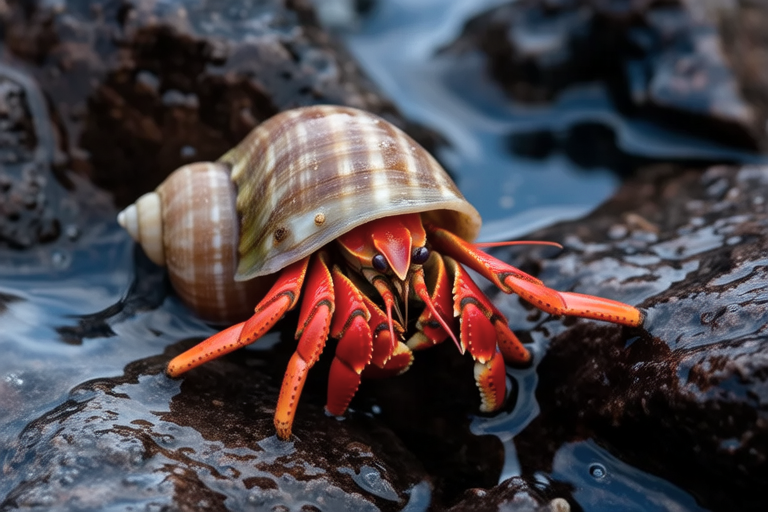
The Unseen Companion: How Pea Crabs Thrive Inside Their Hosts
In the vast and mysterious world of marine life, there exists a fascinating and often overlooked partnership between tiny crustaceans known as pea crabs and their host organisms. These minuscule creatures, barely larger than a thumbnail, have adapted to live inside the bodies of various sea creatures, such as mussels, oysters, and even sea cucumbers. This article delves into the intricate details of this symbiotic relationship, exploring how pea crabs manage to thrive in such an intimate and enclosed environment.
The Symbiotic Relationship
Symbiosis, the living together of two different organisms, can take several forms, ranging from mutualism, where both partners benefit, to parasitism, where one organism benefits at the expense of the other. The relationship between pea crabs and their hosts falls under the category of commensalism, a type of symbiosis where one species benefits while the other is neither helped nor harmed. In the case of pea crabs, they derive protection and a steady supply of food from their hosts, while the hosts remain largely unaffected.
Pea crabs, belonging to the family Pinnotheridae, are found worldwide in coastal waters. They have evolved to live within the mantle cavity of bivalve mollusks, such as mussels and oysters, where they are shielded from predators and the harsh conditions of the open ocean. Their hosts, in turn, provide a stable environment rich in nutrients. This arrangement allows the pea crabs to focus their energy on growth and reproduction rather than survival.
Anatomical Adaptations
To survive within their hosts, pea crabs have developed a series of remarkable anatomical features. One of the most striking adaptations is their flattened body shape, which allows them to fit snugly within the narrow confines of the bivalve’s shell. Their carapace, or upper shell, is typically elongated and rounded, enabling them to maneuver easily within the tight spaces.
Another crucial adaptation is their reduced size. Adult pea crabs rarely exceed 2 centimeters in length, making them small enough to reside comfortably within their hosts. This diminutive stature also helps them avoid detection by predators, ensuring their safety within the protective shell of their host.
Pea crabs have also evolved specialized mouthparts designed for filter feeding. They extend these structures through the host’s gills to catch microscopic particles of food floating in the water. This method of feeding not only provides sustenance but also minimizes disturbance to the host, ensuring the delicate balance of their relationship remains intact.
Behavioral Adaptations
Beyond their physical adaptations, pea crabs exhibit specific behaviors that enhance their survival within their hosts. For instance, they are adept at avoiding the host’s natural defenses. When a bivalve closes its shell in response to threats or stress, pea crabs have learned to retreat deeper into the mantle cavity, away from the closing edges. This instinctual behavior prevents injury and ensures their continued presence within the host.
Additionally, pea crabs display a high degree of social tolerance within their crowded living space. Multiple individuals may inhabit a single host, leading to complex social dynamics. Despite limited resources and close quarters, they coexist peacefully, further demonstrating the intricacies of their relationship.
The Benefits and Drawbacks
For pea crabs, the primary advantage of this symbiotic relationship is protection from predators and environmental hazards. Living within a host shell provides a refuge from external threats, allowing them to focus on growth and reproduction. Furthermore, the constant flow of water through the host’s gills ensures a steady supply of food, reducing the need for extensive foraging efforts.
The benefits for the host are less pronounced but still significant. By hosting pea crabs, the bivalves may gain increased protection from parasites and disease. The crabs’ presence can deter other organisms from entering the host’s mantle cavity, thereby reducing the risk of infection. Additionally, the gentle filtering action of the pea crabs’ mouthparts can help maintain water quality around the host, contributing to overall health.
However, there are potential drawbacks to this relationship for both parties. For pea crabs, the confined space limits their mobility and access to external stimuli, potentially affecting their ability to find mates. While this challenge is mitigated by the close proximity of multiple individuals within a single host, it does introduce some reproductive constraints.
For the hosts, the presence of pea crabs can sometimes lead to increased metabolic demands due to the additional filtration activity. However, studies have shown that this impact is generally minimal, and the overall effect on the host’s health remains neutral or slightly beneficial.
Scientific Insights and Anecdotes
Research into pea crab-host relationships has revealed many fascinating aspects of marine biology. Scientists have observed that pea crabs can influence the reproductive success of their hosts by inadvertently triggering spawning events. When pea crabs release pheromones, they can stimulate the host to release eggs, ensuring a continuous supply of food for the developing larvae. This phenomenon underscores the complexity and interdependence of marine ecosystems.
One notable example of this intricate relationship comes from studies conducted on the European mussel, Mytilus edulis. Researchers found that mussels hosting pea crabs had higher survival rates during periods of environmental stress, such as low oxygen levels. This observation suggests that the presence of pea crabs may confer some level of resilience to their hosts, enhancing their ability to withstand adverse conditions.
The Wonder of Marine Symbiosis
The symbiotic relationship between pea crabs and their hosts exemplifies the incredible diversity and adaptability of marine life. It serves as a testament to the intricate web of interactions that define marine ecosystems. By understanding these partnerships, we gain valuable insights into the mechanisms that sustain life in the oceans and the delicate balance that must be maintained.
The study of pea crabs and their hosts also highlights the importance of conservation efforts aimed at protecting marine habitats. As human activities continue to impact the oceans, preserving these ecosystems becomes increasingly vital for maintaining the health and biodiversity of our planet.
In conclusion, pea crabs offer a captivating glimpse into the hidden world of marine symbiosis. Their unique adaptations and behaviors demonstrate the ingenuity of nature in fostering mutually beneficial relationships. As we continue to explore and understand these partnerships, we deepen our appreciation for the complexity and wonder of life beneath the waves.