
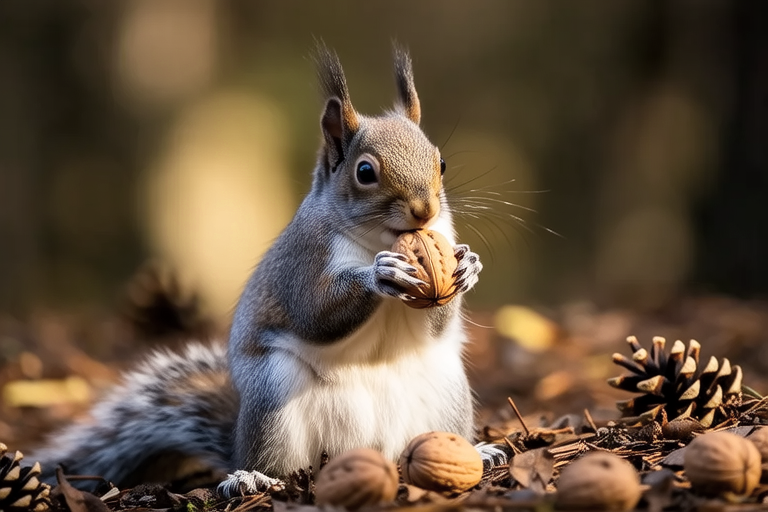
How Smart Are Squirrels? Discover Their Clever Tricks and Behaviors
Squirrels, those ubiquitous creatures darting around parks and backyards, have long been a subject of fascination for both casual observers and scientists alike. Often seen as mere rodents scurrying after nuts, these animals display an impressive array of intelligent behaviors that challenge our understanding of animal cognition. From their remarkable problem-solving abilities to their intricate caching strategies, squirrels prove to be far more than just simple scavengers. This article delves into the world of squirrel intelligence, exploring their adaptability, problem-solving prowess, caching habits, social interactions, urban adaptation, and current research into their cognitive capabilities.
The Intelligence and Adaptability of Squirrels
Squirrels belong to the family Sciuridae, which includes over 200 species ranging from ground-dwelling squirrels to tree-dwelling varieties like the red and gray squirrels common in North America. These animals exhibit high levels of adaptability, thriving in diverse habitats such as forests, grasslands, and even urban environments. Their ability to adjust to various conditions is partly due to their flexible diet, which includes seeds, fruits, fungi, insects, and sometimes even small vertebrates.
One of the most striking aspects of squirrel intelligence is their adaptability in finding food. In natural settings, they must compete with other animals for limited resources. This competition has driven them to develop sophisticated techniques for locating and securing sustenance. For instance, some species have learned to crack open hard-shelled nuts by dropping them onto rocks or roads, taking advantage of human-made structures to aid in their feeding process. This behavior demonstrates not only resourcefulness but also an understanding of cause-and-effect relationships.
Problem-Solving Skills: Real-Life Examples
Squirrels possess remarkable problem-solving abilities that can be observed in both natural and artificial scenarios. A notable example involves their interaction with bird feeders designed to deter smaller birds. Researchers at the University of California, Davis, conducted experiments where they placed feeders equipped with complex mechanisms intended to prevent access by squirrels. Despite these obstacles, many squirrels managed to devise ways to bypass the barriers, often requiring multiple attempts and learning processes.
In another study published in the journal Animal Cognition, researchers tested the spatial memory of eastern fox squirrels by hiding nuts in various locations within a campus setting. The squirrels were able to recall the exact spots where they had buried their caches weeks later, demonstrating exceptional memory retention. This skill is crucial for survival during winter months when food sources become scarce.
Caching Behavior: Remembering Stored Food Locations
One of the most fascinating aspects of squirrel behavior is their caching habit – the act of storing surplus food for future consumption. This practice requires advanced cognitive functions, particularly spatial memory and planning. Squirrels typically cache different types of foods in various locations depending on availability and nutritional value. For example, acorns are often buried singly or in clusters, while seeds may be scattered across larger areas.
To ensure retrieval success, squirrels employ several strategies. Some mark specific trees or landmarks near their caches, using visual cues to guide them back. Others rely on olfactory signals, detecting subtle changes in scent trails leading to hidden stashes. Interestingly, studies suggest that squirrels sometimes engage in deceptive caching practices known as “scatter hoarding.” Instead of placing all their nuts in one spot, they distribute them randomly throughout their territory, making it harder for competitors to locate and steal their reserves.
Social Behaviors and Communication Methods
While squirrels are generally solitary creatures outside of breeding season, they do exhibit certain social behaviors and communicate through vocalizations, body language, and chemical signals. Alarm calls serve as a primary means of warning others about potential threats, such as predators or humans approaching their territories. These calls vary in pitch and duration based on the perceived level of danger, allowing nearby squirrels to assess the situation accurately.
Beyond alarm calls, squirrels also use scent marking to establish boundaries and attract mates. Male squirrels will frequently rub their cheeks against objects or trees to deposit pheromones, signaling their presence to females during mating seasons. Additionally, grooming sessions between mother and offspring play a vital role in bonding and teaching essential survival skills.
Adapting to Urban Environments
The increasing urbanization of many regions presents unique challenges for wildlife, including squirrels. However, rather than being overwhelmed by human development, many squirrel populations have adapted remarkably well to city life. They have found new ways to exploit available resources, such as scavenging from trash bins or raiding backyard gardens.
Urban squirrels have also shown increased tolerance towards humans compared to their rural counterparts. This heightened comfort level allows them to venture closer to residential areas without fear, expanding their range and opportunities for finding food. Furthermore, cities provide numerous artificial structures that mimic natural habitats, offering ample perches and nesting sites.
Ongoing Research Into Squirrel Cognition
Despite decades of research, much remains unknown about the inner workings of squirrel minds. Current studies focus on further unraveling their cognitive processes, particularly regarding decision-making under uncertainty, social learning, and emotional responses. Neuroscientists are increasingly interested in comparing squirrel brain structures with those of primates to identify shared neural pathways responsible for higher-order thinking.
Recent advancements in technology have opened up new avenues for studying squirrel behavior. Camera traps equipped with motion sensors allow researchers to monitor activities remotely, capturing detailed footage of interactions between individuals. Genetic analyses are also shedding light on genetic factors influencing individual differences in intelligence and adaptability among squirrel populations.
As we continue to explore the depths of squirrel cognition, it becomes clear that these seemingly simple creatures possess complex mental faculties worthy of deeper investigation. Understanding their brains could offer valuable insights into broader questions concerning animal consciousness, emotion, and intelligence.
In conclusion, squirrels represent a fascinating blend of instinctive behavior and learned adaptation. Through their problem-solving skills, caching strategies, social interactions, and successful integration into urban landscapes, they showcase impressive levels of intelligence and versatility. Ongoing research promises to uncover even more about the inner workings of these captivating creatures, enriching our appreciation for nature’s diversity.